Marketing has always involved a certain amount of guesswork. You look at what customers have done before, study campaign results, watch what competitors are doing, and make your best prediction about what might work next.
The problem is that there is now far more information to work with. Customers interact with brands through websites, social media, email, search, advertising platforms, and messaging apps. Each interaction produces data. For a marketing team, the challenge is no longer simply finding information. It is making sense of it quickly enough to do something useful with it.
This is where AI is changing digital marketing. AI can analyse large amounts of data, identify patterns, personalise communication and automate repetitive tasks. Generative AI can also help marketers move from a blank page to a first draft, explore creative ideas and adapt content for different audiences.
But AI is not a replacement for marketing judgement. The real opportunity is using it to make better decisions, move faster, and spend more time on the parts of marketing that still require human thinking.

What does AI actually do in digital marketing?
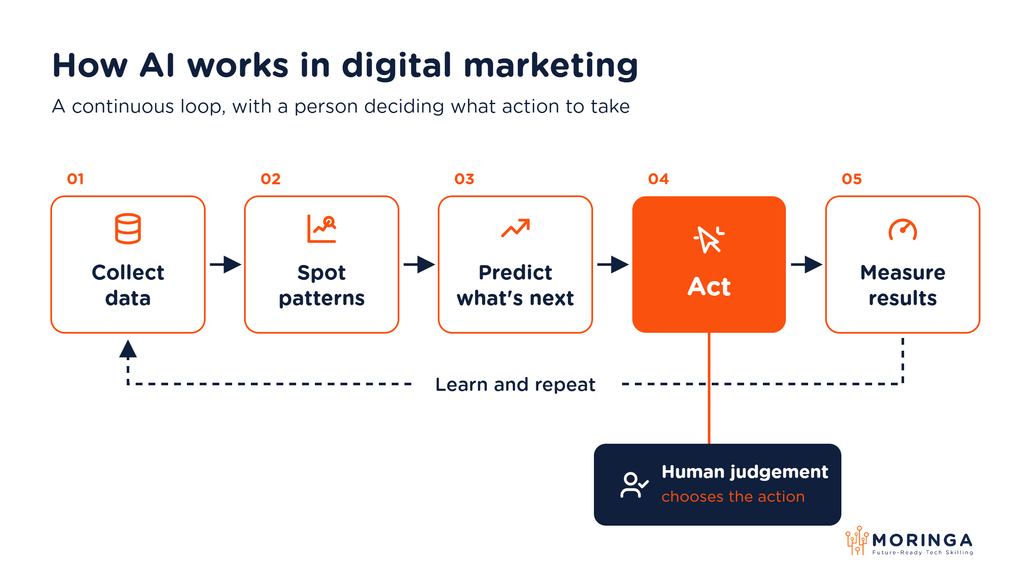
At its simplest, AI in digital marketing helps teams make sense of information and act on it. It can analyse customer behaviour, identify patterns in campaign performance and use those insights to predict what a customer might need or do next.
For example, an AI system can look at browsing behaviour, previous purchases and interactions with a brand to help determine which message, product or offer may be most relevant to a particular customer. That makes personalisation possible at a scale that would be difficult for a human team to manage manually.
AI can also automate parts of the marketing workflow. It can help generate content, organise customer data, identify promising leads, optimise advertising campaigns and analyse performance. The result is not simply more automation. Done well, it gives marketers more useful information to work with and less repetitive work to manage.
How is AI changing digital marketing?
AI is changing marketing in several practical ways.
1. Personalisation at scale
Marketing has traditionally relied on audience segments: groups of customers who share certain characteristics. AI makes it possible to move beyond broad categories by analysing individual behaviours and interactions.
A customer who repeatedly looks at one type of product, for example, may receive different recommendations from someone with a completely different browsing history. The objective is not personalisation for its own sake. It is making communication more relevant.
2. Campaign optimisation
Marketing teams often have to make decisions based on performance data that is constantly changing. AI can analyse campaign performance and identify patterns in audiences, creative formats, placements, and timing. This can help marketers make adjustments faster rather than waiting for a weekly or monthly review.
3. More creative experimentation
Generative AI makes it easier to explore multiple versions of an idea. A marketer can develop different headline options, social media concepts, email subject lines, or visual directions and then use human judgement and campaign data to determine which ones are worth developing further.
The value is not that AI produces the “perfect” piece of content. It is that it can make experimentation cheaper and faster.
4. Better customer journeys
Customers rarely interact with a brand through a single channel. AI can help connect information across different touchpoints and identify what action might make sense next, whether that is sending an email, recommending a product, providing customer support, or connecting someone with a member of staff.
The same thinking extends to sales. Lead scoring, for example, uses engagement, industry and previous interactions to help identify leads that may be more likely to convert, and AI can review sales conversations for recurring objections or pricing concerns. The principle is simple: AI can help salespeople decide where to focus and what to look at next. It does not remove the need for the salesperson.
Where are marketers already using AI?
The practical applications of AI in digital marketing are broad.
1. Generative AI for content
Content teams are under constant pressure to produce more. Blogs, social media posts, email campaigns, landing pages, advertisements, and product descriptions all require time. Generative AI can help marketers get past the blank page and create initial drafts much faster.
It can also adapt a piece of content for different audiences or platforms. But there is an important limitation: AI-generated content still needs a human editor.
Marketers need to check facts, tone, originality, context, and brand voice. Publishing whatever an AI tool produces without review can create bland content, factual errors, or messaging that does not sound like the organisation. AI should accelerate the creative process, not replace the person responsible for the final message.
2. Customer service
AI-powered chatbots, on websites and on messaging apps such as WhatsApp, can handle common questions and provide immediate responses. But customer service applications can go beyond answering FAQs.
AI can help identify customer intent, personalise responses and direct more complicated issues to the appropriate person or department. This can make customer journeys faster while allowing human support teams to concentrate on cases that require judgement or empathy.
3. Understanding customers
Knowing what customers want is at the heart of marketing. AI can process customer data from multiple sources to identify patterns in behaviour, interests and purchase intent. It can also analyse unstructured information such as reviews, survey responses and social media comments to identify recurring concerns or changes in sentiment.
These insights can help marketers improve campaigns, refine products and identify gaps in the customer experience. But data alone does not create understanding. Someone still needs to interpret what the patterns mean and decide what the organisation should do about them.
How does AI change SEO and search visibility?
Search is another area where marketers need to rethink familiar practices. AI is increasingly influencing how people discover information. Search engines are using AI-generated answers and summaries, while users are becoming more comfortable asking conversational questions rather than entering short keyword phrases.
For marketers, this means SEO is no longer simply about inserting keywords into a page. Content still needs to answer real questions clearly, demonstrate useful knowledge, and provide information that people, and search systems, can understand.
AI can help with keyword research, content analysis, identifying related search queries, and reviewing existing pages. It can also help marketers explore long-tail search opportunities and understand the questions audiences are asking.
But marketers should be careful not to let AI turn SEO into a volume game. Producing hundreds of pages simply because AI makes production easier does not automatically create useful content, and it can run against Google’s spam policy on scaled content abuse. Good SEO still starts with understanding the audience.
AI for paid advertising
Paid media is another area where AI can process information faster than a human team. Advertising platforms already use machine learning to help with audience targeting, bidding, and campaign optimisation. Generative AI can also help create variations of headlines, ad copy, and visual concepts.
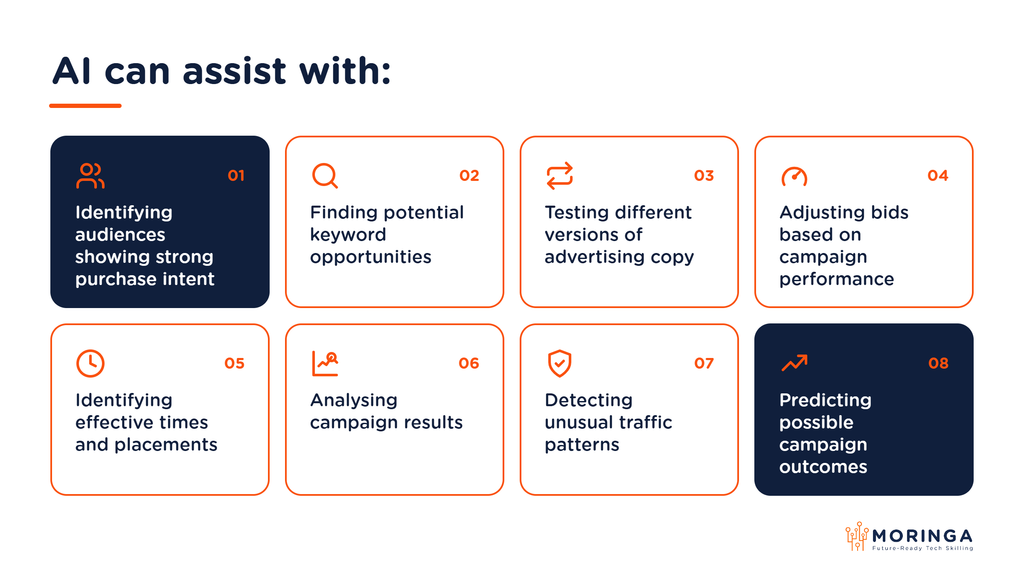
This allows marketers to spend less time making routine adjustments and more time thinking about strategy. But again, automation needs oversight. A campaign can be optimised perfectly against the wrong objective.
Making marketing data more useful
Modern marketing generates enormous amounts of data. Website analytics, advertising platforms, CRM systems, email campaigns and social media all produce performance information. Without the right tools, marketers can spend more time collecting reports than actually using them.
AI can help identify patterns and anomalies in this data. It can highlight unusual changes in campaign performance, identify customer segments, compare historical trends, and help marketers explore questions that would otherwise require extensive manual analysis.
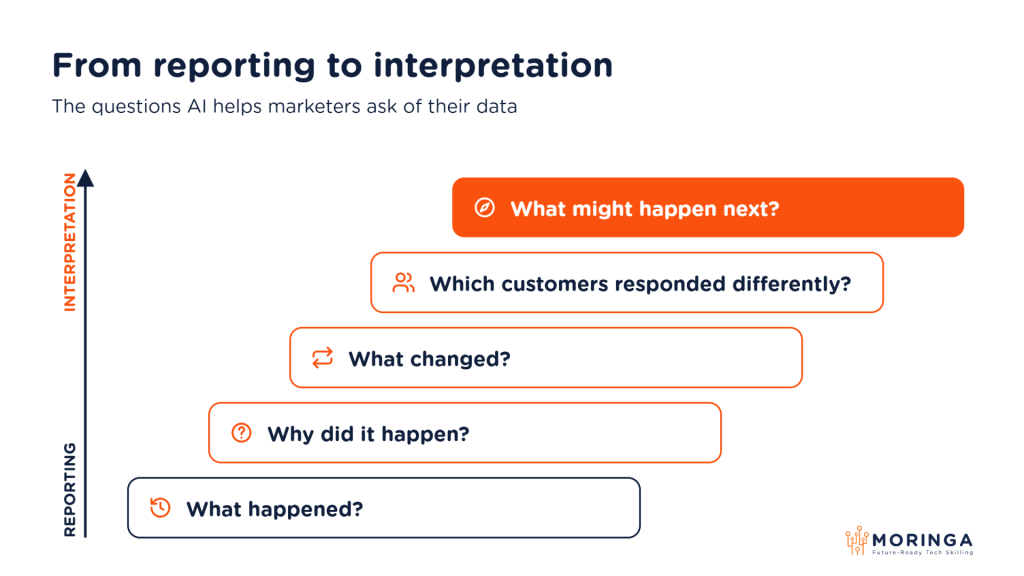
Instead of asking only, “What happened?”, marketers can begin asking better questions:
- Why did it happen?
- What changed?
- Which customers responded differently?
- What might happen next?
That shift from reporting to interpretation is one of the more valuable applications of AI in marketing.
Email marketing gets more personal
Email remains an important marketing channel, but sending the same message to everyone is becoming less effective. AI can help analyse email performance and identify patterns in subject lines, content, timing and engagement. It can also support triggered campaigns based on customer actions.
Someone who signs up for a service, abandons a purchase, or interacts with a particular piece of content can receive a different message based on that behaviour. The goal is not to send more emails. It is to send fewer, more relevant emails.
AI agents for marketing
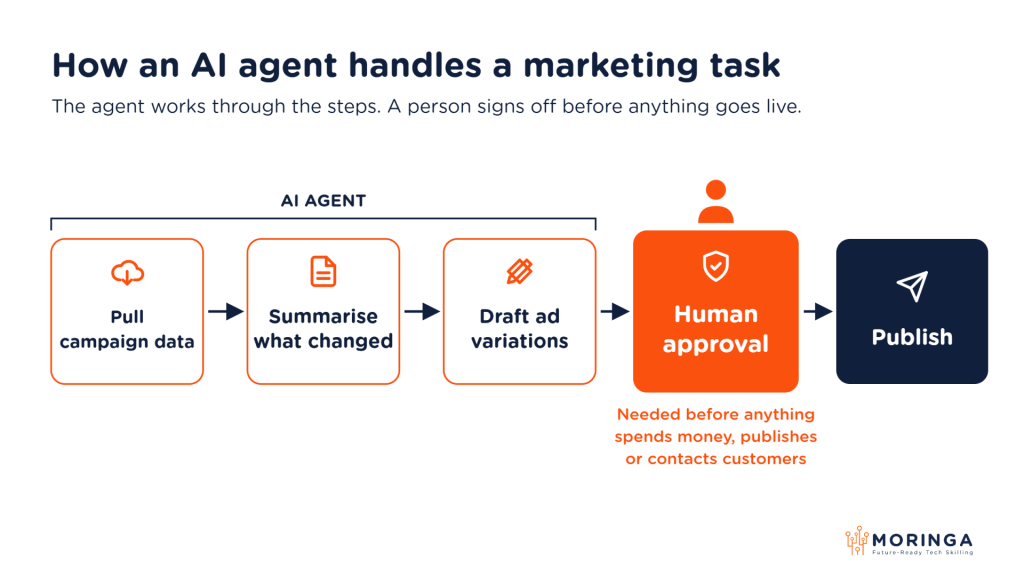
A newer development is the AI agent. Where a chatbot responds to one request at a time, an agent can work through a series of steps towards a goal, using other tools along the way. It might pull together last week’s campaign data, summarise what changed and prepare draft ad variations for a marketer to review.
For marketing teams, the early uses tend to be practical: compiling reports from several platforms, monitoring brand mentions, researching competitors’ public activity, or preparing social media posts for approval.
But agents also raise the stakes of a mistake. An error early in a sequence can carry through every step that follows. That is why it makes sense to keep a person approving anything that spends money, publishes content or contacts customers, and to give an agent access only to the accounts and data the task actually needs.
Which AI tools should digital marketers learn first?
There is no single “best” AI tool for digital marketing. The right choice depends on the problem a marketer is trying to solve.
Tools such as ChatGPT, Claude and Gemini can support research, brainstorming, writing, and data analysis. Image-generation tools such as Adobe Firefly, and the AI features in Canva, can help creative teams explore visual concepts. Automation platforms such as Zapier and Make can connect different applications and reduce repetitive tasks.
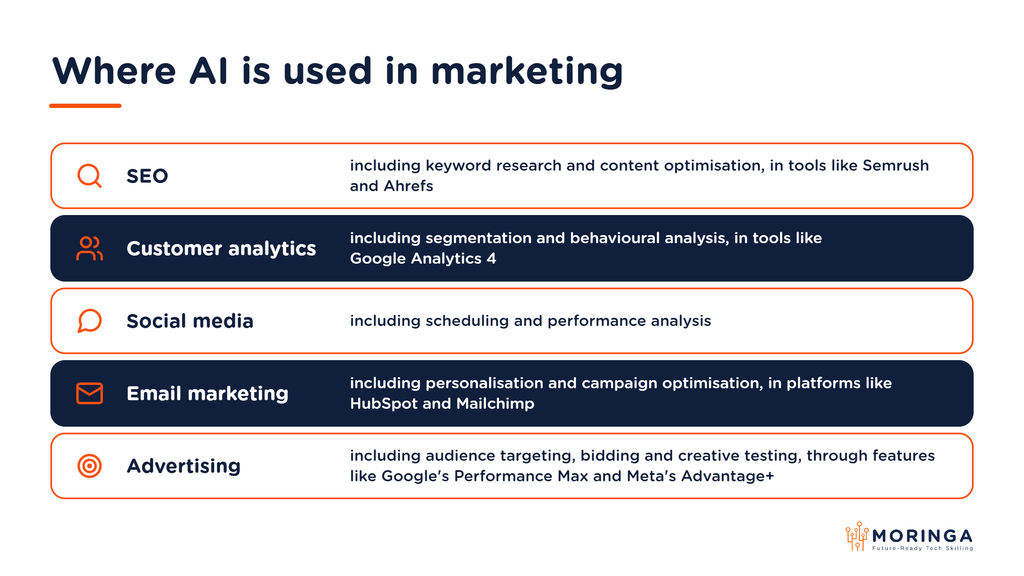
These features change quickly, so it is worth checking what each tool offers today. The important skill is not memorising a list of AI tools. It is learning to identify the marketing problem first and then determine whether AI is actually the right solution.
How to start using AI in marketing
For most marketers, the best place to begin is a single task that takes up too much of the week: a weekly performance report, first drafts of social media posts, or variations of ad copy. Starting small makes it easier to judge whether AI is actually helping.
The quality of the output depends heavily on the context it is given. A vague request produces a generic answer. Compare these two prompts:
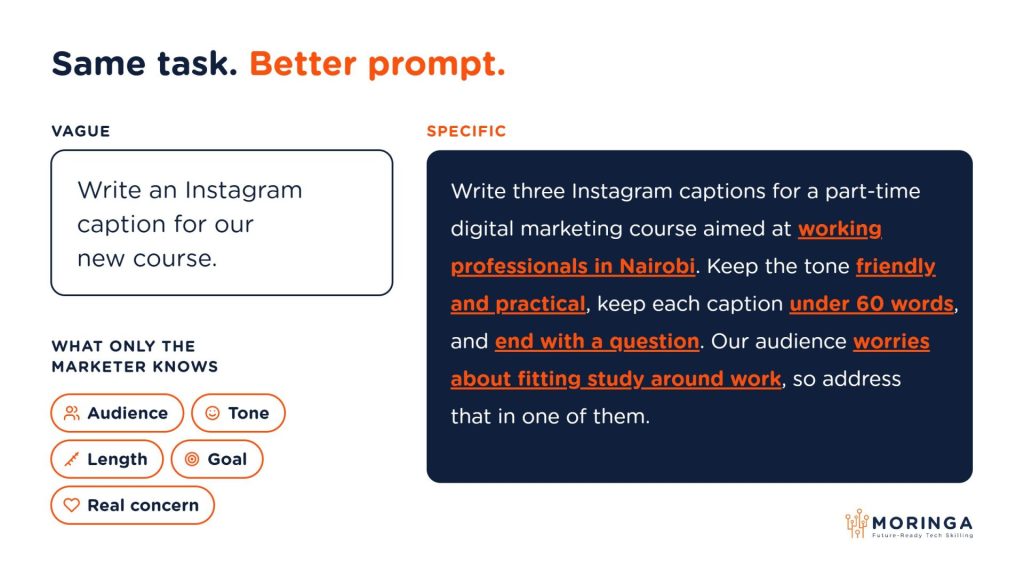
The second prompt includes what only the marketer knows: the audience, the tone, the goal and a real concern. That is usually the difference between a draft that needs rewriting and one that is nearly ready.
From there, the discipline is the same as any other marketing work. Review the output before it goes anywhere, compare the results with the old way of doing things, and keep a record of the prompts that work so the rest of the team can use them.
The risks marketers need to manage
AI brings real benefits, but it also introduces risks that marketers are responsible for managing.
The first is accuracy. Generative AI does not look facts up; it predicts a likely sequence of words, which means it can state an incorrect figure or claim with complete confidence. Google’s guidance on AI-generated content makes the same point: everything should be checked before it is published, including titles and descriptions. Its advice on creating helpful, people-first content applies whether a draft came from a person or a tool.
The second is brand voice. AI drafts often sound alike, regardless of the brand. Giving the tool examples and a style guide helps, but someone who knows the brand still needs to shape the final message.
The third is customer data. In Kenya, the Data Protection Act, 2019 governs how organisations collect and use personal data, and the Office of the Data Protection Commissioner oversees it. For marketers, that means obtaining consent before using personal data for direct marketing, making it easy for people to opt out, and thinking carefully before pasting customer details into public AI tools. (This is general information rather than legal advice.)
Where human skills still matter
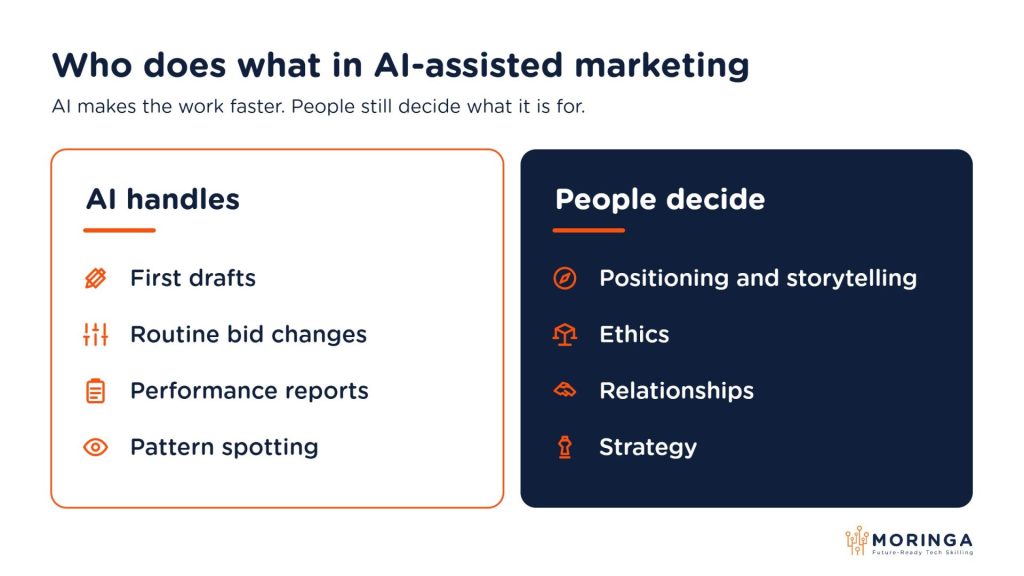
The growth of AI in marketing can create the impression that eventually everything will be automated. That is unlikely to be the most useful way to think about the technology. Marketing still depends on human strengths that AI cannot simply reproduce.
Storytelling and positioning: AI can produce dozens of versions of a message, but people still need to decide what the brand should stand for and what story is worth telling.
Ethics: Just because customer data can be used for highly precise targeting does not mean every possible use is appropriate.
Relationships: Particularly in complex B2B sales and high-value purchases, trust remains a human factor.
Strategic thinking: A marketer can connect information from a campaign, a customer complaint, a competitor’s activity, and a change in the wider market in ways that may not be obvious from individual datasets.
AI can make marketing more analytical and efficient. It does not make human judgement irrelevant.
How can I learn AI for digital marketing in Kenya?
For marketers, the question is no longer whether AI belongs in the profession. The more useful question is how to use it well. Marketers do not necessarily need to become machine learning engineers. They need to understand how AI can support the work they already do and where its limitations lie.
There is also an important distinction between learning how to use AI tools and understanding how to apply them effectively. The latter requires practice. It means knowing how to structure a problem, provide useful context, evaluate an AI output, check information, and decide when human review is necessary. That is particularly relevant as organisations in Kenya look for professionals who can combine existing expertise with practical AI skills.
This is the thinking behind Moringa’s Digital Marketing with AI programme, which approaches AI from a practical, career-focused perspective. If you already run campaigns and want to use AI with confidence, our Digital Marketing with AI course is a part-time remote programme built around real marketing work.
AI for marketers is about better decisions, not just faster work
The biggest opportunity AI creates for digital marketers is not simply the ability to produce more content in less time. It is the ability to make marketing more informed. Instead of relying entirely on assumptions, marketers can use AI to analyse customer behaviour, identify patterns, test ideas, personalise communication and respond more quickly to changes.
But the technology works best when it is paired with people who understand marketing. That is why learning AI should not mean abandoning the fundamentals of the profession. Audience understanding, creativity, positioning, storytelling, ethics, and strategic thinking still matter, and the goal should be to build on those strengths rather than replace them.
Whether through no-code AI training, short practical programmes, or more advanced technical learning, the most valuable AI education is the kind that helps professionals move from experimenting with tools to applying them confidently to real problems. AI can reduce the guesswork. But marketers still have to decide what questions are worth asking.