
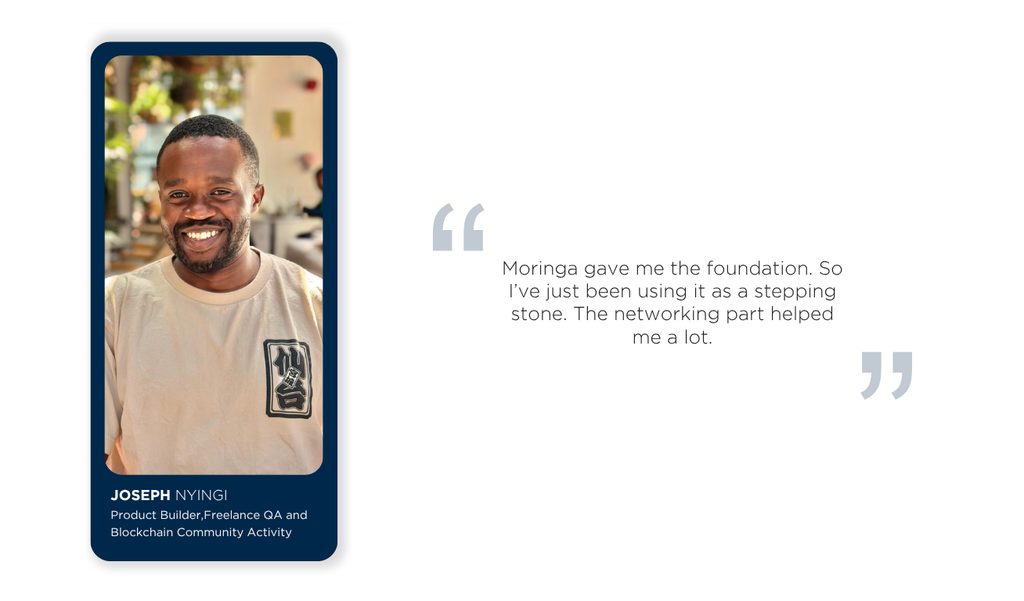
“Moringa gave me the foundation. So I’ve just been using it as a stepping stone.” Joseph Nyingi, Data Science Graduate (2021)
Joseph’s first step after graduating was an internship in technology and data consulting. Today he’s building a weather and storm early-warning product for farmers.
That’s a common path. In a 2026 study of 350 of our alumni, the most common first opportunity was an internship, and most alumni who found one got it within six months. Pay moved too: the share earning KES 100,000 or more a month rose from 4.3% before Moringa to 24.6% by the time of the study.
So, do bootcamp graduates get jobs in Kenya? Many find a first opportunity fast, but it often starts smaller than you might expect.
Key takeaways
- Speed: about 8 in 10 of our alumni (78.6%) started using their skills within six months.
- First step: often an internship (29.1%). A foot in the door, not the finish line.
- Pay: 24.6% of our alumni now earn KES 100,000+ a month, up from 4.3% before Moringa.
- Career growth: 7 in 10 (70.0%) report moderate or significant progress, and 46.3% have done freelance work.
- The catch: these are results for our alumni. We can’t promise them for you.
Want to see the source? Download the Moringa Graduate Impact Study 2026 for FREE. The research was run independently and draws on a survey of 350 alumni, 6 focus groups with 43 alumni, a survey of 14 employers, and 3 employer interviews.
Hiring or training a team? Read Kenyan Companies Keep Training Staff. Why Is the AI Skills Gap Still Here?
How fast do Moringa graduates find a first opportunity?
Fast, for most who find one. Of our alumni who landed a first opportunity, such as an internship or a job, 7 in 10 (70.9%) got it before graduation or within six months. By the one-year mark, 86.3% had one. Separately, 78.6% of all 350 said they started using their Moringa skills within six months.
Now the catch. A first opportunity isn’t always a permanent job. Most often (29.1%), it’s an internship. The Kenya Association of Manufacturers described it like this: a three-month internship, three more months, then a longer contract.
So read this as speed, not a placement rate. Internships count.
Applied to dozens of jobs and heard nothing? We get it. These numbers are a starting point, not a promise. Tell our admissions team where you’re starting from (school leaver, graduate, career changer, or working professional), and they’ll suggest a route. Chat with us on WhatsApp
Do Moringa graduates earn more afterwards?
Many do! Of 299 alumni who gave before-and-after answers, 200 (66.9%) moved up to a higher range. The share earning KES 100,000 or more a month rose from 4.3% to 24.6%.
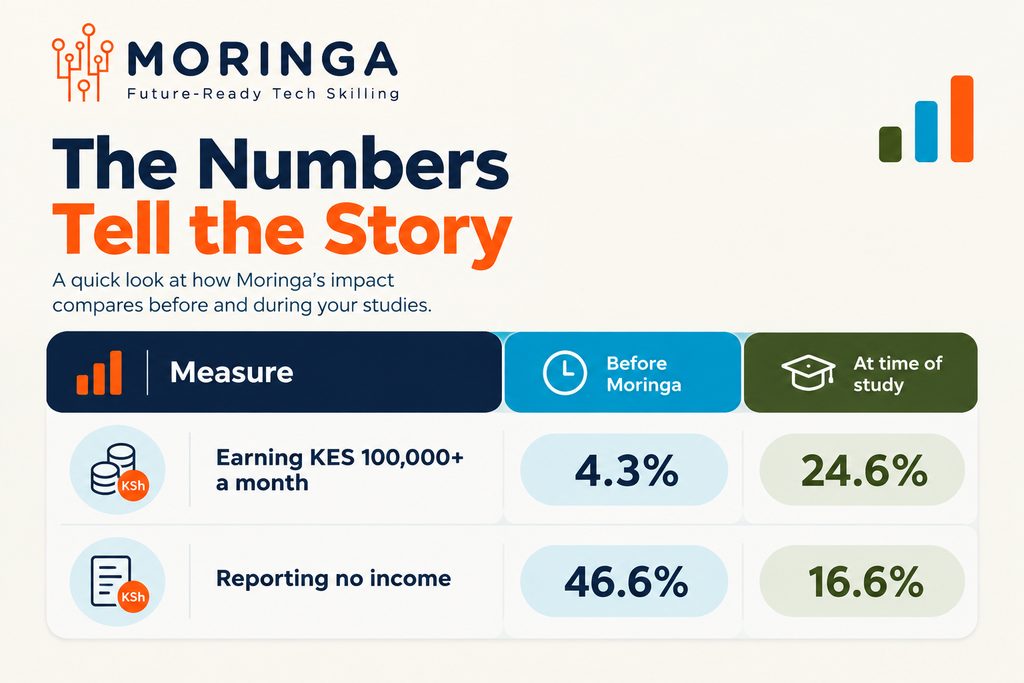
That’s 5.7x as many people!
If you’re starting from zero, this bit is for you.
163 of our alumni had no income when they joined. By the time of the study, 114 of them were earning, and 37 were earning KES 100,000 or more a month.
Where you start matters.
Of those who joined as students, 62.3% reported higher income than before. Of those who joined unemployed, 51.2% did. These are patterns, not proof. Pay also depends on experience, effort, networks, and the job market. Moringa helped; it did not do everything.
What comes after the first job?
More than one path. 7 in 10 of our alumni say they’ve made moderate or significant progress since finishing. That looks like:
- 44.3% took on more responsibility
- 41.7% got a pay rise
- 41.4% changed roles
- 23.1% were promoted
46.3% have earned freelance income. And 20.2% of those asked run or co-own a business.
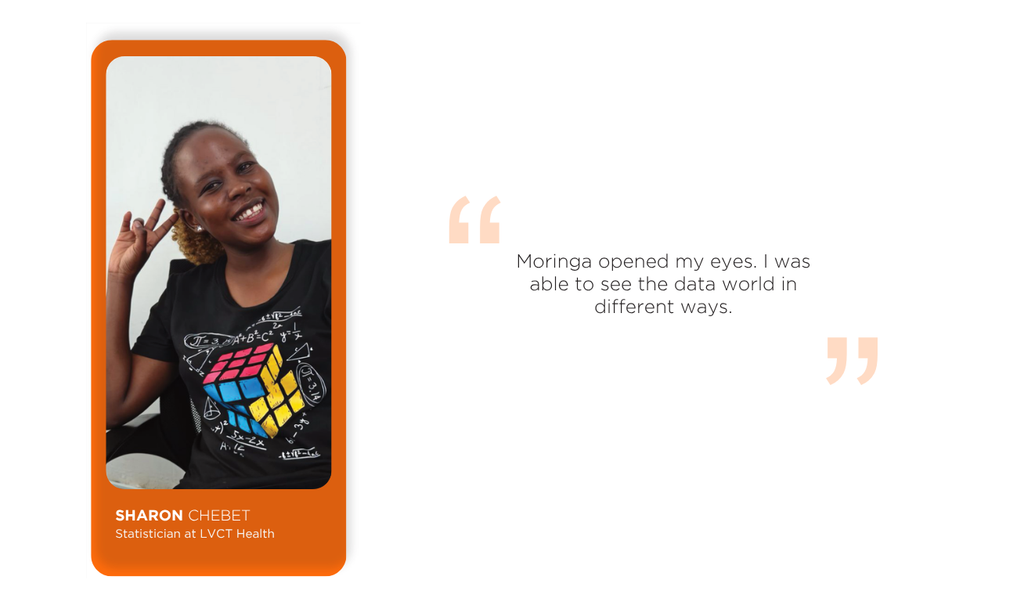
Joseph isn’t the only one. Sharon Chebet was already working in data when she joined our part-time Data Science Bootcamp. She wanted to close gaps in programming, automation, and machine learning. She’s now a statistician at LVCT Health.
Zacharia Kamau was in our 2022 Full Stack Software Engineering Bootcamp cohort and now works at KiotaPay. His advice if you’re just starting: package yourself for the global market, and keep building projects.

Our alumni also told the researchers what helped:
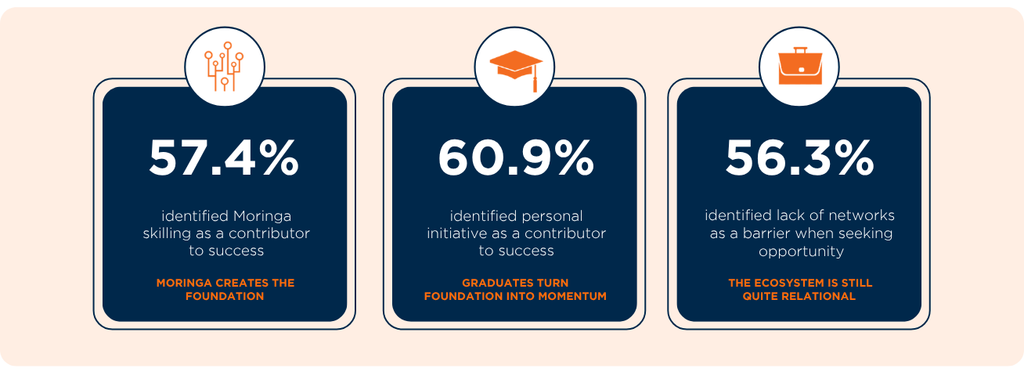
- 60.9% said their own initiative.
- 57.4% said Moringa skills.
- And 56.3% said not having a network held them back. Keep this in mind when you plan your own route.
Want career-change stories? Read Stephen Gathai’s move from finance to data science and Your Guide to Data Science Careers.
What do employers say about Moringa graduates?
More than 800 companies have hired Moringa talent across technology, telecommunications, financial services,
aviation, retail, consulting, the public sector and other industries.
Of the 14 employers surveyed, 71.4% rated our graduates above or well above other entry-level hires. All 14 said technical skills were a strength, and all said they’d probably or definitely hire from us again. The most common thing to improve was communication.
Only 14 of the 51 organisations contacted answered. E-Biashara credited its graduates’ “hands-on experience from Moringa.” Apollo Group / APA Insurance said our graduates would be stronger with more business sense: the knack of spotting a cheaper or faster way to do something.
How should you read these numbers?
Read these numbers with healthy scepticism. That goes for any school’s numbers, ours included. This is good evidence, not a guarantee:
- People gave their own answers. Income and career changes come from surveys.
- Each number counts a different group. So don’t compare the percentages directly.
- Moringa helped, but wasn’t the only factor. Effort, networks, and the job market matter too.
- Few employers answered. Fourteen, so it’s a rough guide.
What should you look for in a bootcamp?
If you’re looking for a bootcamp in Cybersecurity, Data Science, Software Engineering, or AWS DevOps, ask how the school counts its results, and look for real work with real employers. Before you enrol, ask:
- How do you define “placed,” and over what timeframe?
- Will I work on live projects or internships with real employers?
- Will I build communication and business skills, not just code?
- How will I build a network, and keep learning afterwards?
Not sure which route fits you? Tell us your starting point and your goal, and we’ll help you work it out. Chat with us on WhatsApp or read the study yourself: Graduate Impact Study 2026.
Frequently asked questions
Do bootcamp graduates get jobs in Kenya?
Many find opportunities quickly, but no honest source can guarantee one. In Moringa’s 2026 study of 350 alumni, 70.9% of those who found a first opportunity got it within six months and 86.3% within a year.
How much do Moringa graduates earn?
The share of alumni earning KES 100,000 or more a month rose from 4.3% before Moringa to 24.6% at the time of the study. Results vary with starting point, programme, and job market.
Is the Moringa graduate study independent?
Okinyo Mark’s Management Consultancy ran the Graduate Impact Study 2026 independently, and Moringa published the public brief. The alumni results are solid enough for institution-level reporting. The employer results (14 organisations) and programme-level comparisons are treated as directional.