
At the end of the month, salaries land, rent goes out and payment traffic spikes across Kenya. Many of the apps handling that rush run on cloud infrastructure that a team built, automated and can scale up in minutes. That’s cloud computing and DevOps at work, and it’s why cloud skills now matter well beyond infrastructure teams.
For developers and IT professionals in Kenya, the shift opens a clear path. DevOps, which joins software development and IT operations, is where cloud skills turn into a job. It’s also one of the most searched routes into tech: people look up “devops engineer”, “AWS” and “cloud computing courses in Kenya” to find out where to begin.
This guide covers why cloud skills matter, how they’ve changed what employers expect, what that means in Kenya, and seven practical steps to start building them.
Why cloud skills matter for today’s technology careers
Cloud skills matter because the work itself has moved. Whether you build apps, analyse data or keep systems secure, the infrastructure underneath now lives in the cloud. Here is what that looks like in practice.
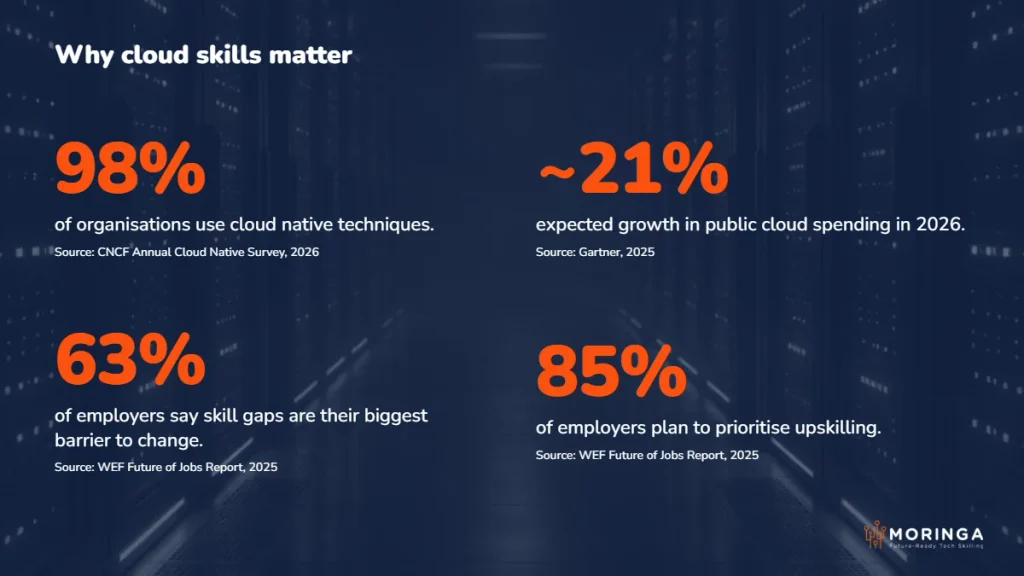
- Software now runs on the cloud by default. Organisations keep moving more of their systems to cloud platforms, and they keep spending more on them. Gartner’s 2026 public cloud spending forecast expects growth of about 21%. As a result, someone has to set up, secure and run all of those systems.
- The tools have become standard. A few years ago, containers and Kubernetes felt experimental. Today, 98% of organisations in the Cloud Native Computing Foundation’s latest survey use cloud native techniques. In other words, knowing these tools is no longer a bonus on a CV. It is expected.
- AI runs on cloud infrastructure. Much of the excitement about AI hides a simple fact: models need servers, storage and pipelines to run. The same CNCF survey found that two in three organisations hosting generative AI models use Kubernetes to run them. So if you want to work near AI, cloud skills get you in the room.
- Employers are short of these skills. In the World Economic Forum’s Future of Jobs Report 2025, 63% of employers named skill gaps as the biggest barrier to changing their business. The fastest-growing skills on its list, networks and cybersecurity, AI and big data, and technological literacy, all lean on cloud know-how.
- Skills now age faster. The same report estimates that 39% of workers’ current skills will change or become outdated by 2030. Cloud skills are one of the most practical ways to keep your own skills current, because they sit underneath so many roles.
- Teamwork is now the hard part. Interestingly, CNCF found that the top barrier to cloud adoption is no longer technical. It is cultural change within development teams. That is exactly the gap DevOps fills.
Put simply, cloud skills have moved from a niche for infrastructure specialists to a foundation for most technology careers.
How cloud has changed what employers expect
Cloud has not only created new jobs, such as DevOps engineers and cloud engineers. It has also changed what employers expect from people already working in tech. As a result, cloud capability now shows up in job descriptions that never used to mention it.
- Software developers. Many teams now expect developers to deploy and support their own code, not hand it over to a separate operations team. Knowing how your app runs in the cloud, and why it fails, has become part of the role.
- Testers and QA engineers. Manual testing at the end of a project is giving way to automated tests that run inside deployment pipelines on every code change. Testers who understand those pipelines are far more valuable.
- Data professionals. Data increasingly lives in cloud storage and cloud data warehouses rather than on local machines. Analysts and data engineers now work with cloud tools to store, move and process it.
- Cybersecurity specialists. Securing systems now means securing cloud accounts, permissions and configurations. Consequently, cloud knowledge has become a core part of security work.
- IT support and systems administrators. Racking servers and installing software by hand is giving way to cloud consoles, scripts and automation. The job remains, but the toolkit has changed.
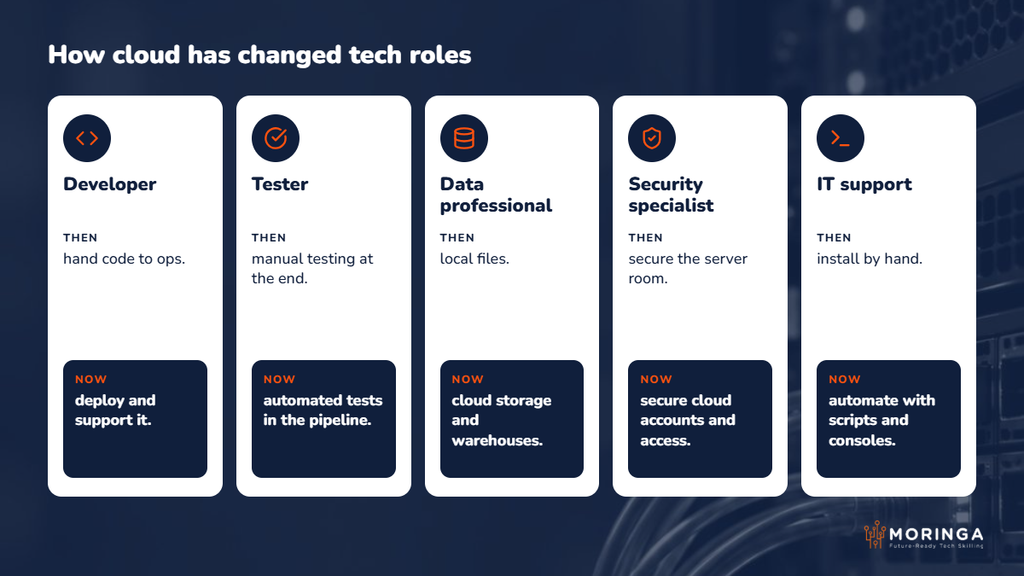
The World Economic Forum reflects this shift: 85% of employers surveyed plan to prioritise upskilling their workforce. For individuals, cloud skills are increasingly what lets you grow within a role rather than be left behind by it.
Cloud computing and DevOps: why they go together
Cloud gives teams infrastructure they can create in minutes; DevOps is the set of practices that lets them use it safely and often. One without the other rarely works well.
Before cloud, adding a server could mean buying hardware and waiting weeks. Releases were large, infrequent and risky. Today a team can describe its servers, networks and permissions in a file, check that file into Git, and recreate the whole setup on demand. That idea is called Infrastructure as Code.
Here is the path a typical code change travels in a modern team:
- A developer pushes code to a shared repository such as GitHub or GitLab.
- A CI pipeline (continuous integration) builds the code and runs automated tests.
- The application is packaged into a container, a standard box that runs the same way on a laptop or a server.
- A CD pipeline (continuous delivery) deploys it to cloud infrastructure, often managed by Kubernetes.
- Monitoring tools watch performance and errors, and what they find shapes the next change.
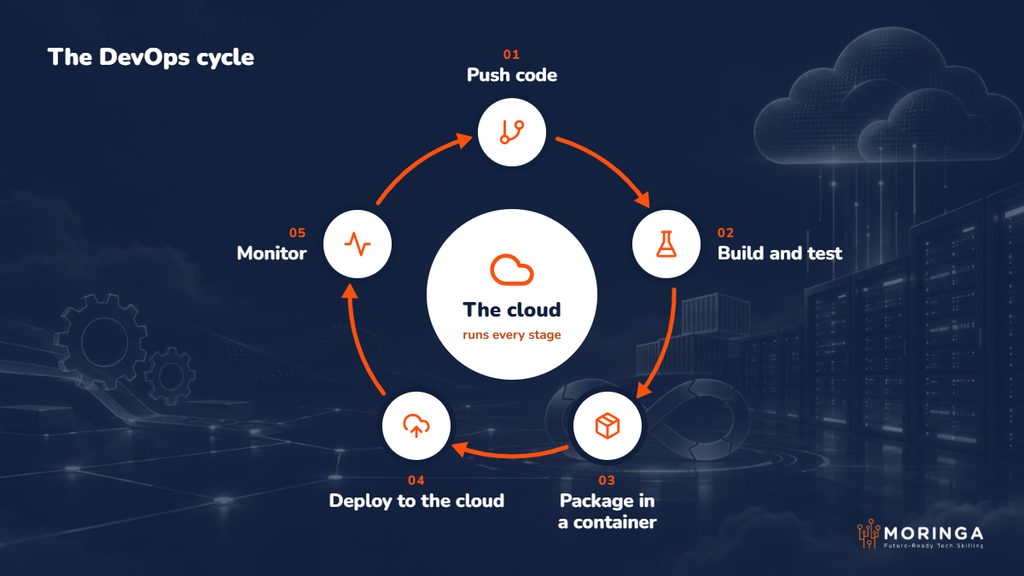
Every step depends on cloud skills: knowing how networks, permissions, storage and compute fit together. A developer who understands that path can ship work, fix problems faster and talk with operations and security teams in their own language.
The cloud skills employers look for
Employers rarely hire for a single tool. Instead, they look for a set of connected cloud skills that let someone run software reliably. These are the ones that come up again and again in DevOps and cloud job descriptions.
- Linux and the command line. Most cloud servers run Linux. You need to move around a server, read logs, manage permissions and restart services without a graphical screen.
- Cloud fundamentals. This means understanding compute, storage, networking and identity on at least one platform, such as AWS, Microsoft Azure or Google Cloud. Identity and access management (IAM) deserves special attention, because most cloud security problems start with too much access.
- Infrastructure as Code. Tools like Terraform and Ansible let you describe servers and networks in files. Consequently, you can review, repeat and roll back infrastructure changes the same way you handle code.
- CI/CD pipelines. Continuous integration and continuous delivery automate building, testing and deploying software. Jenkins, GitLab CI and GitHub Actions are common choices.
- Containers and orchestration. Docker packages an app with everything it needs, while Kubernetes runs many containers at scale and restarts them when they fail.
- Monitoring and reliability. Once software is live, someone has to know when it breaks. Tools such as Prometheus and OpenTelemetry help teams spot problems early and recover quickly.
Human skills matter just as much. The World Economic Forum ranks analytical thinking as the top core skill employers want. In DevOps, that shows up as calm troubleshooting, clear documentation and the ability to explain a trade-off to developers, managers and security teams alike.
An entry-level badge such as AWS Certified Cloud Practitioner can show you know the basics. However, a project that you built, broke and fixed tells an employer far more about how you work.
Cloud skills in Kenya: the talent opportunity
For Kenya, the cloud story is mainly a people story. Many employers still see a skills gap holding them back, especially in areas such as technological literacy, cybersecurity and networks. Yet according to a World Economic Forum analysis of Sub-Saharan Africa, almost half of employers in the region expect talent availability to improve by 2030, compared with 29% globally. They expect this thanks to a young and growing workforce.
That gap is where the opportunity lies. Many Kenyan businesses and start-ups already build on global cloud platforms, and they need people who can run those systems well. Moreover, cloud work is well suited to remote roles, so a skilled engineer in Nairobi, Mombasa or Kisumu can support teams anywhere in the world.
Oracle has chosen Nairobi’s iXAfrica data centre to host a planned public cloud region, and local infrastructure is growing too. Over time, investments like this bring more cloud work closer to home. In short, the region has the people and a growing market. What it needs is more of those people with practical, job-ready cloud skills.
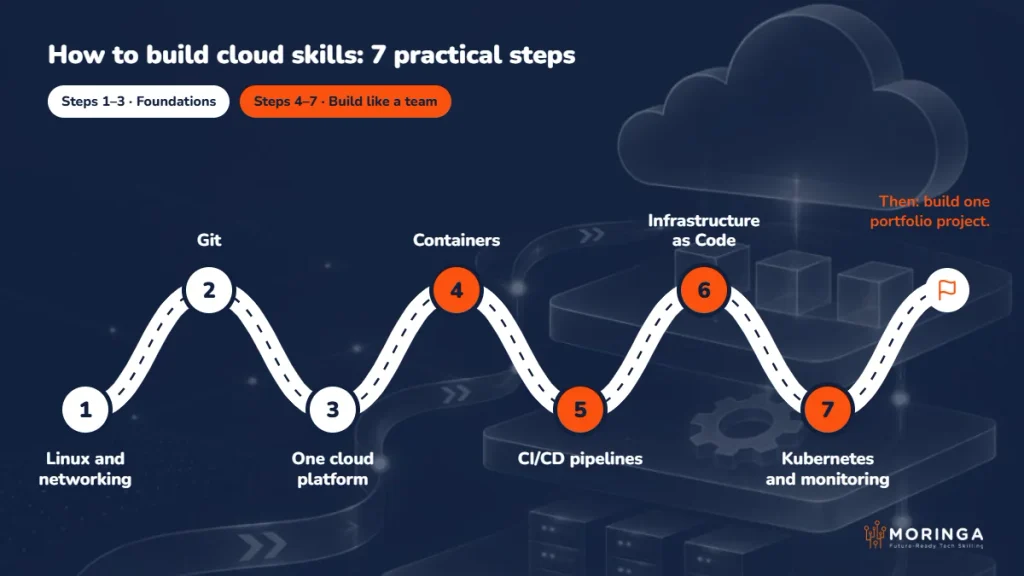
Step 1: Get comfortable with Linux and networking
Most cloud servers run Linux, so this is where everything starts. Install Ubuntu on a spare machine or in a virtual machine, and use the terminal for daily tasks: moving between folders, editing files, changing permissions, checking running processes and reading logs. Alongside that, learn the networking basics, such as IP addresses, ports, DNS and how a web request travels from a browser to a server. These are the first things you will check when something breaks.
Mini-project: set up a simple web server such as Nginx, open the right port, and load the page from another device on your network.
Step 2: Use Git like a professional
In cloud teams, Git stores far more than application code. It also holds infrastructure definitions, pipeline settings and configuration files. Learn branching, pull requests, resolving merge conflicts and writing clear commit messages. Then put every project from this list on GitHub or GitLab from day one, because together they become your portfolio.
Step 3: Learn one cloud platform properly
Pick one provider, such as AWS, Microsoft Azure or Google Cloud, and stay with it until the basics feel natural. Each offers a free tier and free learning paths. Focus on four building blocks: compute (virtual machines), storage, networking (virtual networks and firewalls) and identity and access management (IAM). The core ideas carry across providers, so depth in one makes the others easier later.
Two habits will save you money and stress. First, set a billing alert the day you open your account. Second, avoid using the main “root” account for daily work; create a separate user with only the permissions it needs.
Mini-project: move your web server from Step 1 onto a cloud virtual machine, and allow only the traffic you expect through its firewall.
Step 4: Package an app in a container
Take a small app you have already written, such as a simple to-do API, and package it with Docker. Run it on your laptop, then on your cloud machine. You will quickly see why containers matter: the app behaves the same way everywhere. Next, use Docker Compose to run the app and its database together, which mirrors how real systems are built.
Step 5: Automate testing and deployment with CI/CD
This is where your work starts to look like a real cloud or DevOps role. Build a pipeline with a tool such as GitHub Actions or GitLab CI that runs every time you push code. It should run your tests, build your container and deploy it to the cloud automatically. Keep passwords and access keys out of your code; store them in your pipeline tool’s secrets settings instead.
Mini-project: make a small change to your app, push it, and watch it reach your live server without touching the server yourself.
Step 6: Describe your infrastructure in code
Now recreate your cloud setup with an Infrastructure as Code tool such as Terraform. Write your virtual machine, network and firewall rules as code, preview the changes, and apply them. Then delete everything and rebuild it from your files. When you can tear down and recreate your whole environment in minutes, you understand Infrastructure as Code, and you keep your cloud bill low by removing resources you are not using.
Step 7: Run and monitor your app at scale
Finally, learn the basics of Kubernetes, the tool most organisations use to run many containers at once. You do not need a paid cluster; free tools let you run a small one on your laptop. Deploy your app, scale it up and down, and roll out a new version. Then add simple monitoring so you can see requests, errors and memory use. Being able to answer “is it working, and how do we know?” is one of the most valued skills in cloud work.
Bring it together: combine Steps 4 to 7 into one portfolio project, and write a clear README explaining what you built, the choices you made and what you would improve. That document often impresses employers as much as the code, because it shows how you think.
Common traps to avoid
- Tutorial hopping: watching course after course without building anything rarely sticks.
- Learning three clouds at once: depth in one platform beats shallow knowledge of three.
- Ignoring costs: forgotten resources can quietly run up a bill, so check your account regularly.
- Chasing certificates alone: certifications help, but they work best alongside projects you can show and explain.
If you already work as a developer, you are closer than you think. Much of cloud and DevOps work applies habits you already have, such as version control, testing and review, to infrastructure.
How the industry is reshaping tech education in Kenya
The way software is built is changing, so is the way people learn to build it and employers are driving that shift. In the World Economic Forum’s Future of Jobs Report 2025, employers named reskilling and upskilling as the two policies most likely to improve the talent available to them, and 85% said they plan to prioritise upskilling their own teams. What they want is clear: developers who can write code and also ship it, automate it and keep it running in the cloud.
For most developers, that gap shows up at a familiar moment. The feature works on your laptop and the tests pass. Then the code has to reach real users, and suddenly the questions change: where does it run, how does it get there safely, and why did it slow down overnight? In more and more teams, the person expected to answer those questions is the developer.
Moringa’s Introduction to DevOps Engineering course is built around that demand, structured for software developers who want to move from writing code to owning how it reaches users. Most of the time goes into doing the work itself: writing the Terraform that creates a cloud environment, building pipelines that test and release code on every push, and running applications on Kubernetes. Things break along the way, and working out why is where much of the real learning happens.
It all comes together in a capstone project, a working system that each learner designs, automates and deploys. That project tends to outlast the course. It gives a developer something concrete to walk an employer through, with real decisions to explain, which is exactly the kind of practical, job-ready skill that employers keep saying is in short supply.
The gap between what developers learn and what employers need is closing from both sides. Industry is making its expectations clearer, and training is being rebuilt around them. For developers who already write code, that makes cloud and DevOps skills less of a leap and more of a natural next step in their careers.
Cloud skills are a career foundation
Cloud computing and DevOps now shape how most software is built and run, and that has changed what the industry expects from almost every technology role. Developers, testers, data professionals and security specialists are all being asked to understand how their work runs in the cloud. Meanwhile, employers in Kenya and across the region still report a skills gap, and training is changing to close it.
The good news is that you do not need to learn everything at once. Start with Linux and one cloud platform, build one project at a time, and keep your work public. Step by step, cloud skills will turn from a topic you read about into the foundation of your technology career.
Ready to take your code all the way to the cloud? See how our DevOps course fits around your current role.